
Featured leadership appointment
Kristina Thomas • May 20, 2024
Appointment to the Executive General Manager, Clinical at VCGS
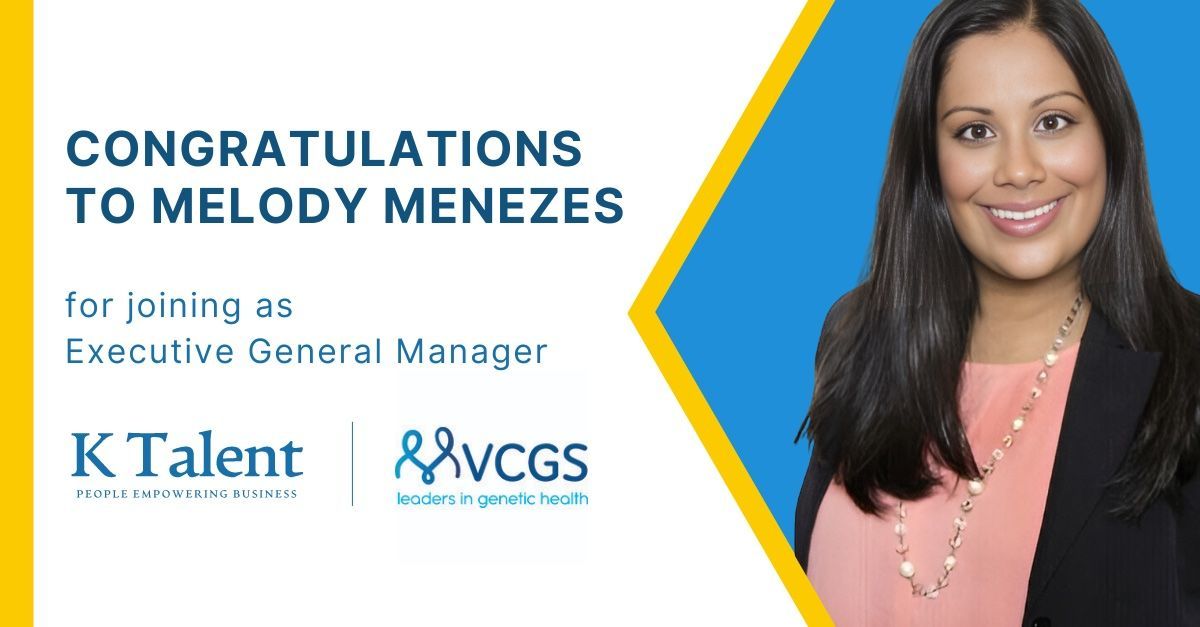
We have been delighted to work with the Victorian Clinical Genetics Services (VCGS) to appoint Melody Menezes as the new Executive General Manager, Clinical. Congratulations to Melody and we look forward to the contributions she will make.
Related blogs

The Change Paradox: Why the Right Leader Can Still Struggle! "We need a leader who will transform this organisation." Nine months later: "They are changing too much, too quickly." Sound familiar? This is one of the most common leadership transition traps: the gap between what an organisation says it wants and what it is actually prepared to support. The job description says: Transform the organisation. Challenge the status quo. Drive change. Everyone around the interview table nods in agreement. But there is a difference between the role on paper and the job in reality: The role is the title, the goals and the purpose. The job is what people will actually let you do once you start. So the new leader starts doing exactly what they were hired to do. Instead of support, they hear: "They're moving too fast." "They don't understand how things work here." "They're not respecting our culture." Why does this happen? Boards are often aligned with the strategic outcome. What they can't fully predict is how the organisation will respond once change becomes personal. It is easy to support change when it is an idea, when the focus is on the positive outcome. What the organisation will gain from the change, and what the future could look like. It is much harder when change affects roles, influence, processes, relationships and ways of working. When the reality of what needs to change becomes clear, the focus often shifts from what will be gained to what will be lost. And are the losses worth the gains? The organisation wanted transformation. But it was only prepared for change that didn't feel too uncomfortable. The role of leadership transition This is why leadership transition matters just as much as the hiring decision. Finding the leader with the right skills is really important. But the organisation also needs to be prepared for the leadership it has asked for. Without that alignment, even the right leader can struggle, not because they lack capability, but because the conditions around them make success difficult. This is particularly true in health, medical research and NFP organisations, where success isn't measured by profit alone. Success there is a balance of purpose, values, care, stakeholder expectations and financial sustainability, often while navigating competing priorities and perspectives. Change can become even more challenging. Every leadership appointment creates both opportunity and loss. There will always be things to gain and things to let go of. Leadership transition is about helping the organisation navigate that balance: aligning expectations, understanding the reality of the role, and creating the conditions for the leader and organisation to succeed together. We spend months deciding who to appoint. We spend remarkably little time preparing the organisation for what that appointment will require. Yet that is often the difference between an appointment that succeeds and one that struggles. What are your thoughts? #Organisationalpsychology #Changeparadoxinleadership #leadershiptransition #ExecutiveAppointmentStrategy

The Real C-Suite Dilemma in Health and Academia: Has Leadership Changed More Than We Realise? When a CEO vacancy arises within a hospital, medical research institute, university or large not-for-profit organisation, boards often find themselves asking a familiar question: Do we appoint our outstanding internal expert, or do we search externally? It is an understandable debate, but perhaps it is the wrong one. The more important question is whether we have fully recognised how much the CEO role itself has changed. The Changing Face of Health and Academic Search For decades, organisations across healthcare, higher education and medical research were led by individuals whose technical expertise gave them enormous credibility. Outstanding clinicians, eminent researchers and respected academics often progressed naturally into executive leadership. It made sense. These organisations existed to improve patient outcomes, advance scientific discovery or educate future generations, and their leaders understood that mission better than anyone. Today, however, the environment in which these organisations operate looks very different. Funding models have become increasingly fragile. Competition for research grants continues to intensify. Philanthropic giving is harder won. Universities are grappling with changing student markets, while health services face growing demand, workforce shortages and relentless financial pressure. Ironically, the success of these organisations now depends not only on the quality of their research, teaching or clinical care, but on their ability to remain financially sustainable enough to continue delivering them. The changing nature of leadership Many boards continue to evaluate leadership through the lens of technical expertise. However, the role of the executives has evolved into something fundamentally different. Today's CEO must balance mission with sustainability. They must navigate and take accountability for government policy, commercial partnerships, workforce strategy, organisational transformation, governance, political complexity and financial stewardship, all while protecting the institution's purpose. In many respects, they are no longer leading the expertise itself. They are leading the conditions that allow expertise to flourish. That distinction is subtle, but profoundly important. The Danger of the "Eminent Expert" Blind Spot A world-leading researcher may have demonstrated extraordinary intellectual capability and secured significant funding, but that does not automatically translate into the ability to lead enterprise-wide transformation. A highly respected clinician may have unparalleled credibility in their field, but executive leadership requires additional capabilities: strategic judgement, commercial understanding, stakeholder management, communicating clearly with the board, the ability to navigate ambiguity and the willingness to make difficult decisions where there are no perfect answers. This is not an argument against technical experts becoming CEOs. Some of the most effective leaders in healthcare and academia bring deep expertise from their profession. The issue is assuming that expertise alone is sufficient. The Risk of Looking Outside Without Understanding Context Equally, appointing an external executive is not inherently less risky. An accomplished leader from another sector may possess exceptional commercial capability, but underestimate the cultural, political and stakeholder complexity that exists within purpose-led organisations. A strong executive appointment is not simply about finding the most impressive individual. It is about understanding the relationship between the leader and the environment they are entering. Leadership Success Depends on More Than Capability As an organisational psychologist, I have become increasingly convinced that boards and executives invest significant effort in assessing the capability of candidates, yet comparatively little attention is given to assessing the conditions those leaders will inherit. Leadership success is rarely determined by capability alone. It emerges from the interaction between the individual and the environment in which they are expected to lead. Even highly capable leaders can struggle when expectations are unclear, governance is misaligned, stakeholder dynamics are poorly understood or the organisation is not ready for the change it requires. Conversely, the right leader, supported by the right conditions, can create extraordinary outcomes. This is why executive appointments require more than assessing experience, achievements and reputation. They require understanding the psychological and organisational factors that influence whether a leader can succeed in a particular environment. Rethinking Executive Appointments The question facing boards is therefore not whether the successful candidate comes from inside or outside the organisation. The question is whether the board and the executives have objectively assessed the capabilities required to lead this organisation, in these circumstances, at this point in its evolution. That requires looking beyond reputation, tenure and technical achievement. It requires understanding the complexity of the environment the leader will inherit and what support they will need to succeed. Executive appointments have become one of the most consequential decisions boards make. Yet they are still often approached as though leadership has remained unchanged. The solution for modern health, medical research and NFP boards is not to choose between internal succession and external recruitment. It is to reduce appointment risk by understanding the challenges on the ground, assessing candidates objectively and creating the conditions for the appointed leader to succeed. Because in health, academia and the NFP sector, leadership failure is never just a financial issue. It impacts research outcomes, patient care, workforce confidence and community trust. ------- Are you currently evaluating internal succession pipelines for an upcoming C-suite or clinical director vacancy? Contact KTalent today to discuss how our organisational psychology lens can benchmark your talent and secure your institution's future #organisationalpsychology #leadershipappointment #Executivesearchinhealth #executivesearchinhigheducation #executivesearchinresearch

They look perfect on paper, but will they deliver in our specific environment? If you are an executive looking for your next C-suite appointment, this is the ultimate question. When organisations talk about hiring leaders, the conversation usually revolves around experience, capability, and results. -Can they deliver? -Have they led teams of this size? -Do they have industry experience? But there's another question that often gets treated as secondary or ignored altogether: "Are they the right fit for this organisation, at this moment in its evolution?" I'm not talking about "culture fit" in the outdated sense of hiring people who look, think, or behave the same. I'm talking about alignment between a leader and the environment they will be expected to navigate. Every organisation has a unique combination of strategy, maturity, pace of change, stakeholder dynamics, decision-making style, and appetite for risk. A leader who excels in one context can struggle in another, not because they are less capable, but because the conditions are fundamentally different. Think of it like this: the lion is the king of the animal kingdom, but he would struggle in the Arctic. He hasn't lost his strength, his hunting instincts, or his inherent capability, but the conditions matter more. We spend enormous effort validating technical capability and surprisingly little understanding organisational context or the behavioural demands it places on a leader. Most of the context barely gets mentioned in a position description. As the pace of change continues to accelerate, this matters more than ever. To increase your chance of success in your executive team appointment, look beyond the resume and into the conditions your new leader will walk into. These will likely matter more than expected. Leadership success isn't determined by capability alone. It's determined by how capability interacts with your specific context. Do you assess environmental fit before making a high-stakes leadership hire? #ExecutiveLeadership #CEOInsights #ExecutiveAppointmentStrategy #CSuiteHiring #SuccessionPlanning
For most of my career in recruitment and executive search, one question has fascinated me: Why do some leadership appointments thrive while others struggle? With a background in organisational psychology, my interest has always extended well beyond making placements. I've been just as interested in what happens after the appointment, because it is what happens after the appointment that ultimately determines whether a leader succeeds or not. Executive search is a critical part of that story. Finding the right leader matters. But after years of watching leaders transition into organisations, I noticed the same pattern emerging. When highly capable leaders struggled, it often wasn't because they were the wrong appointment. It was because they had stepped into conditions that made success unnecessarily difficult. If you looked at where most organisations invest their time and resources, you could be forgiven for thinking the formula for leadership success is simple: Leadership Success = Individual Capability Find the best leaders. Run a rigorous search. Conduct robust assessments. Make the appointment. All of that matters. But I've come to believe the equation is incomplete. We’ve all seen organisations where the same leadership role changes hands every few years, yet still struggles to create impact. Different people, different personalities, different skill sets. Yet the outcome remains below expectations. The role, not the leader, consistently underdelivers. And in some cases, these roles are avoided by very capable leaders. When the same pattern repeats, it’s worth asking whether we are putting too much focus on leadership skills alone. Today, I’d describe leadership success like this: Leadership Success = Individual Capability × Conditions Capability is essential. But capability alone doesn't determine whether a leadership appointment succeeds. Success also depends on the conditions surrounding that leader: the organisational context the stakeholder alignment the clarity of mandate the governance the expectations the internal politics These aren’t qualities of the leader coming into the role. They’re qualities of the system the leader is stepping into. When these conditions are misaligned, even highly capable leaders will struggle. In some cases, this leads to early exits, repeated turnover, or leaders remaining in role but unable to deliver sustained impact. This naturally raises an important question: What can organisations do to improve these conditions and maximise the likelihood of leadership success? Executive search identifies the right leadership capability. Leadership transition creates the conditions for that capability to flourish. -- If you are currently navigating a leadership appointment or supporting a newly appointed executive, you may be encountering some of the dynamics described above. These situations are rarely straightforward and often benefit from structured transitions. If you would like to know more on how we help organisations navigate leadership appointments or leadership transitions, connect with us on LinkedIn or reach out for a conversation. You can also explore more insights on our blog or connect with us on LinkedIn to follow future articles.